
Let’s have a conversation
The Challenge: Efficiency Matters When Every Chart Counts
Hybrid HEDIS season (aka Retrospective HEDIS project) requires accuracy, speed and coordination across analytics, operations and provider networks… all under intense time pressure. Plans are expected to close gaps at scale while navigating evolving specifications and a growing dependency on chart retrieval and medical record completeness.
Too often, teams are forced into reactive workflows:
- Chasing charts without prioritization
- Manually flagging members
- Relying on inconsistent provider responses

What Successful Plans Are Doing Differently
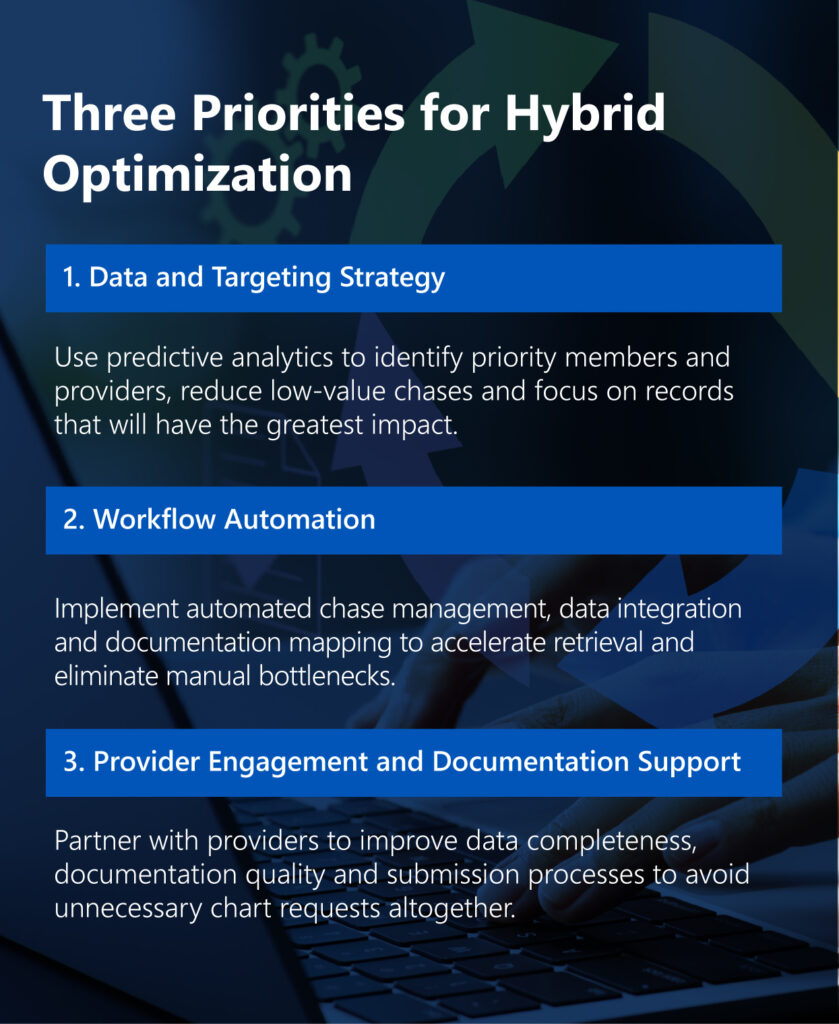
High-performing plans are shifting away from manual, sprint-based chart hunts to data-driven hybrid strategies. They are:
- Using advanced data analytics to improve their hybrid sample and prioritize high-impact members and providers early
- Automating chart chase workflows to reduce manual effort and enhance retrieval accuracy
- Engaging providers before hybrid season to improve documentation quality and reduce chart volume, not just chase records
These plans recognize that faster chart retrieval alone isn’t optimization. True efficiency comes from reducing avoidable chart work and creating workflows that scale year over year.
They are also:
- Strengthening supplemental data capturethroughout the year
- Improving ETL processes to ensure cleaner, more reliable data
- Making insights accessible through dashboards and self-service reporting for quality, clinical and operational teams
Our Perspective
With upcoming deadlines from NCQA and CMS regarding ECDS measure changes, digital quality measurement and FHIR based APIs, hybrid season as we know it is evolving.
However, the investments plans make now to optimize today’s programs will directly enable success in what comes next. Prospective HEDIS efforts will continue. Improved SDS capture and next-generation tools, such as natural language processing and large language models, will further enhance clinical data capture. At its core, this evolution is about one thing: ensuring plans capture the most accurate, most relevant clinical data to drive better outcomes for members… today and in the future.