Author: Tricia Egry

Before You Build a Roadmap, Know Where You Stand

The transition to digital quality measurement is accelerating, yet many health plans are making technology, staffing and vendor decisions without a clear understanding of their current readiness. Before building a roadmap or investing in new capabilities, organizations need an objective view of where they stand today across governance, data, operations, technology and workforce readiness.

A structured assessment of a health plan’s IT ecosystem, HEDIS operations, data infrastructure and measure performance establishes an evidence-based baseline before major roadmap, investment or vendor decisions are made.

Organizations often assume digital quality readiness is primarily a technology challenge, In reality, success depends on aligning governance, people, operational workflows, data quality and technology investments. Without that broader understanding, even well-funded initiatives can struggle to deliver expected results.

Our assessment follows a structured five-stage approach, designed to establish an objective baseline before organizations commit to transformation initiatives.

  • Discovery & Stakeholder Interviews: Understand governance, decision-making, data ownership and how HEDIS operations function across the organization.
  • Data & Systems Review: Clinical data sources, system architecture and supporting documentation are reviewed to trace how data moves from point of care through to measure reporting.
  • Measure-Level Benchmarking: Current measure performance is analyzed against peer and national benchmarks to understand relative standing and identify which measures are most affected by the shift to ECDS and digital methodologies.
  • Maturity Scoring: Findings from across all three areas, baselined across industry standards, are then scored against a five-domain maturity model, providing a consistent, defensible way to compare current-state capability across the organization.
  • Roadmap Development: A sequenced set of recommendations, organized by effort, cost and impact, helping organizations prioritize initiatives in the order that delivers the greatest value.

Our assessment evaluates five interconnected dimensions of digital quality readiness; not just technology, but the people, processes, data, systems and operating model that must evolve together to support digital quality.

  • Operating Model & Governance: How quality operations are structured today, including decision rights, escalation paths and cross-functional ownership across quality, IT, clinical operations and compliance, along with how accountability for measure performance is distributed across those groups.
  • Data & Interoperability Maturity: Investigation of the clinical data ecosystem supporting quality measurement, including EHR connectivity, health information exchange participation, FHIR API readiness and the reliability of existing data pipelines and integration points.
  • Measure Performance & Benchmarking: Measure-level analysis to identify where performance gaps may create the greatest operational or regulatory risk as digital reporting expands.
  • Workforce & Execution Capacity: Alongside the data itself, the internal capability supporting it, including clinical informatics expertise, data literacy and technical staffing, and where current roles and team structures align with the requirements of ECDS and digital quality measurement.
  • Technology & Vendor Enablement: QMIS, EHR, HIE and other analytics vendor partners that support these workflows are evaluated for FHIR and ECDS readiness, integration maturity and contract terms that may support or constrain future-state capability.

Together, these five areas form a complete view of current-state readiness, not just a technology assessment, but a full picture of the people, process, data, systems and operating models that will need to evolve together.


Digital quality transformation requires more than implementing new technology. It requires alignment across:

  • Governance
  • Operations
  • Data
  • Workforce
  • and Vendor Strategy to achieve meaningful, sustainable results

ProspHireโ€™s Digital Quality Readiness Assessment helps health plans establish an objective baseline, identify the greatest risks and opportunities and prioritize investments that will have the greatest impact. Combining deep HEDIS expertise with experience leading healthcare transformation initiatives, we help organizations move beyond assessment to an actionable roadmap for execution. Before investing in digital quality transformation, establish a clear understanding of where your organization stands today. A structured readiness assessment creates the foundation for smarter investments, stronger alignment and more successful execution.


Scaling Without Breaking What Made You Successful

Growth is often celebrated in healthcare. New locations. New markets. New patients. New opportunities. But growth itself isn’t the achievement. The real challenge is sustaining performance while scaling.

In the latest episode of Soaring to New Health, Dan Crogan sat down with Dave Gaspar and Dr. John Poczatek of Smile Partners, alongside ProspHire Dental Practice Leader Luke Laurin, to discuss what growth looks like behind the scenes. Their conversation revealed an important reality facing healthcare organizations today: successful growth isn’t driven by acquisitions, technology or expansion plans alone. It’s driven by execution.

Growth Magnifies Everything

One of the most interesting themes from the discussion was that growth doesn’t eliminate operational challenges. It amplifies them.

Processes that worked when an organization had a handful of locations may begin to break under the weight of expansion. Communication becomes more complex. Change management becomes more difficult. Leadership teams must balance consistency with flexibility.

As Gaspar noted throughout the conversation, every practice is different. Organizations that assume every acquisition, integration or expansion will follow the same blueprint often discover quickly that reality is far more nuanced.

The most successful organizations approach growth with humility. They spend time understanding what is already working before introducing change.

Culture Doesn’t Scale Automatically

Many organizations focus on systems, technology, and operational efficiencies during periods of growth. Those things matter. But culture remains one of the most importantโ€”and most overlookedโ€”factors in successful expansion.

The Smile Partners team emphasized the importance of maintaining a human-centered approach throughout integrations and operational changes. Whether supporting a newly acquired practice or helping teams adapt to new workflows, face-to-face engagement and relationship building remain critical.

This reflects a challenge many healthcare organizations face today. Leaders often assume culture will naturally extend as the organization grows. It rarely does.

Culture requires intentional investment, communication and visibility from leadership. Without it, growth can create distance between teams, locations and organizational goals.

Change Management Is About Empathy

Another key takeaway centered on change management. Healthcare leaders frequently focus on the technical side of change: new systems, new workflows, new processes.

Yet the biggest obstacles are often human.

What may appear to be a minor operational adjustment can feel significant to employees who have spent years building routines, making decisions and developing successful ways of working.

The discussion highlighted a simple but powerful principle: people need to feel heard before they can embrace change.

Organizations that acknowledge concerns, explain the “why,” and involve teams in the process are far more likely to achieve adoption than those that rely solely on mandates and timelines.

Standardization Without Losing Identity

One of the most difficult balancing acts in healthcare growth is determining what should be standardized and what should remain flexible. Too little standardization creates inconsistency. Too much standardization can undermine the unique strengths that made an organization successful in the first place.

The conversation explored how Smile Partners approaches this challenge by maintaining clear expectations around critical operational and clinical standards while preserving autonomy where it matters most.

This approach allows organizations to gain the benefits of scale without erasing the local expertise, relationships and culture that drive performance.

The Real Measure of Growth

Perhaps the most important insight from the episode was that growth should never become the goal itself. The goal is impact. Growth simply creates the opportunity to extend that impact to more patients, providers, employees and communities.

Organizations that scale successfully understand this distinction. They evaluate growth not only through financial performance or expansion metrics but through patient experience, employee engagement, clinical quality and operational effectiveness.

As healthcare organizations continue to navigate consolidation, workforce pressures and increasing operational complexity, the winners will not necessarily be the fastest-growing organizations.

They will be the organizations that execute growth well.

Because in healthcare, and especially in dental practice management, execution remains the differentiator.

Listen to the Full Episode

Hear the full conversation with Dave Gaspar, Dr. John Poczatek, Luke Laurin and host Dan Crogan on the latest episode of Soaring to New Health.

2027 CMS Program Audit Protocols

What Medicare Advantage Plans Need to Know

Key Changes in the 2027 Program Audit Protocols

  • CMS plans to replace universe tables with the quarterly Service Level Data Collection for Initial Determinations and Appeals. Until that reporting is fully implemented and available, universe tables will continue to be used
  • What this means for Health Plans: The shift from audit-specific universe table submissions to quarterly Service Level Data Collection reporting increases the importance of ongoing data integrity and positions audit readiness as a continuous, year-round activity for MAPD plans.
  • The updated protocols enhance audit efficiency and clarity through expanded CDAG, ODAG and SNPCC universe fields, standardized root cause analysis templates, and a simplified CPE questionnaire. CMS also reduced reporting burden by removing FA Table 4 and most ODAG universes, with those data elements transitioning to the Service Level Data Collection. A new ODAG universe for reopened Part C redeterminations was also introduced
  • What this means for Health Plans: Organizations that wait until audit season will struggle to meet these expanded documentation expectations. Leading plans should begin strengthening data validation, governance and audit readiness processes now.
  • CMS added three new compliance standards addressing integrated HRAs, Medicaid coordination assistance, and hospital/SNF admission notifications. The SNPCC universe was also enhanced with new data elements to better capture and assess D-SNP care coordination activities.
  • What this means for Health Plans: For health plans, these updates reflect CMSโ€™s increasing focus on ensuring meaningful integration and coordination between Medicare and Medicaid services for D-SNP members. Recent regulatory developments, including the Final Rule, signal heightened oversight in this area, making it critical for plans to evaluate and strengthen their D-SNP integration processes, document coordination activities, and ensure compliance with evolving Medicare-Medicaid coordination requirement

While several protocol updates reduce reporting burden, the brooder direction from CMS is clear: audit readiness is becoming a year-round operational capability rather than an annual compliance exercise. Organizations that invest now in stronger governance, documentation and data quality will be better positioned for future audits and evolving regulatory expectations. expectations.

We help Medicare Advantage organizations:

  • Strengthen audit readiness
  • Improve universe accuracy
  • Build sustainable compliance processes
  • Prepare for evolving CMS requirements

Talk with our Medicare Advantage experts about preparing for the 2027 audit changes.

Soaring to New Health Blog, Season 4 Episode 3

Medicare Stars Is Changing. The Plans That Adapt Will Win.

The Medicare Advantage Stars program is entering a period of significant change.

CMS continues to shift the program away from administrative and process measures and toward outcomes, clinical performance and member impact. For health plans, that means the strategies that drove success in the past may not be enough to sustain performance in the future.

In Episode 3 of Soaring to New Health, Bill Rayball, Vice President of Government Quality at Highmark and ProspHire’s Andrew Bell discuss what these changes mean for plans and where leaders should be focused now.

Stars Success Is No Longer a Quality Team Responsibility

One of the strongest themes from the conversation was that Stars performance cannot live within a single department. Quality teams may lead the strategy, but success requires alignment across clinical operations, provider networks, member experience, customer service, analytics and executive leadership.

As Stars becomes increasingly tied to outcomes, plans that create stronger cross-functional accountability will be better positioned to maintain performance.

HEDIS Modernization Is Reshaping the Future

Both guests pointed to HEDIS modernization and digital quality measurement as one of the most important shifts underway. As healthcare moves toward greater interoperability and FHIR-enabled data exchange, plans will need more than strong abstraction teams and supplemental data strategies. They will need modern data infrastructure, better clinical data acquisition and the ability to turn information into actionable insights.

The plans investing in these capabilities today will have a significant advantage tomorrow.

Stability Is the New Strategy

For years, Stars organizations focused on continuous improvement and incremental gains. That mindset remains important, but the environment has changed. Regulatory shifts, evolving measures and increasing performance pressure mean many plans are now focused on protecting performance as much as improving it.

According to Rayball and Bell, the organizations that will succeed are those with strong leadership, clear priorities and the discipline to focus on the initiatives that truly move the needle.In a time of constant change, stability may be the most valuable capability a health plan can build.

Hear the full conversation with Bill Rayball and Andrew Bell as they discuss the future of Medicare Stars, HEDIS modernization and what health plans should be doing now to prepare for what’s next. To listen to the entire episode, clickย here.

Digital Quality Measurement: Why HEDISยฎ Success Depends on More Than Technology

Across CMS and NCQA, quality measurement is intentionally shifting from slow, expensive, and laborious abstraction toward fast healthcare interoperability resources (FHIRยฎ)-enabled systems. These new systems will fundamentally alter HEDISยฎ as we know it. They will usher in a whole new mechanism for measuring performance, one that is continuous and real-time, upending existing workflows, processes, and procedures. This shift toward digital quality measurement represents a fundamental change in how quality performance is measured, managed and improved.ย As opportunities for retrospective remediation continue to diminish, payors that fail to prepare, risk falling behind in quality performance and operational efficiency and long-term competitive advantage.

The transition to digital quality measurement is not an overnight phenomenon. Rather, itโ€™s the natural evolution of a quality measurement ecosystem that has been moving steadily toward greater automation, interoperability and timeliness for more than a decade.

Historically, HEDISยฎ relied heavily on administrative claims and expensive manual medical record review. Payors invested significant resources and capacity each year in chart retrieval, abstraction and supplemental data collection to close gaps in what could not be identified through claims alone. Performance was often determined months after care was delivered, with plans racing against the clock during HEDISยฎ/Hybrid season to locate documentation and maximize measure rates.

Digital quality measurement (dQM) represents the next stage of this progression. Powered by Fast Healthcare Interoperability Resources (FHIRยฎ), digital quality measures are designed to leverage standardized, structured clinical data exchanged directly between systems. The goal is to create a more automated, scalable and near real-time approach to quality measurement, reducing administrative burden while improving accuracy and transparency.

As plans move along this continuum from traditional HEDISยฎ to ECDS and ultimately to digital quality measurement, the nature of quality operations fundamentally changes.

Success becomes less dependent on:

  • Chart chase
  • Abstraction
  • And retrospective remediation

and more dependent on an organizationโ€™s ability to:

  • Capture
  • Structure
  • Exchange
  • Govern clinical data at the Point of Care

In many cases, the challenge is not the technology itself but the operating models, governance structures and workflows needed to support a more continuous and data-driven approach to quality measurement.

This evolution is being driven intentionally by both CMS and NCQA. CMS has repeatedly emphasized the need to reduce provider and payer burden through interoperability and digital reporting, while NCQA’s Digital HEDISยฎ roadmap continues to transition measures away from hybrid methodologies and toward ECDS and digital-only reporting. As this shift accelerates, opportunities for late-cycle corrections will continue to diminish. Organizations that invest now in the people, processes, technology and governance required to support digital quality measurement will be better positioned to succeed in the future state of HEDISยฎ.

For many payors, the transition to digital quality measurement can feel overwhelming. The temptation is often to focus immediately on technology, FHIRยฎ implementation or interoperability requirements. While those capabilities are critical, organizations that succeed will recognize that digital quality measurement is as much an operational transformation as it is a technical one. The organizations making the greatest progress are aligning leadership, quality, clinical operations, IT, provider engagement and compliance around a shared vision for the future state.

Many organizations discover that their greatest challenges are not rooted in technology alone but in fragmented ownership, inconsistent processes and operating models that were designed for a retrospective, chart-driven environment.

From there, the focus should shift toward learning and experimentation. Digital quality measurement represents a fundamentally different way of measuring performance and organizations benefit from testing new approaches in controlled environments before attempting enterprise-wide transformation. Early pilots allow plans to better understand how digital measures behave, where data gaps exist, how clinical concepts are represented across systems and what operational changes may be required to support future-state measurement. These experiences often provide insights that cannot be identified through planning exercises alone.

As organizations mature, attention increasingly turns toward operationalizing the future state. This often involves reevaluating clinical data acquisition strategies and developing a more intentional approach to how data is sourced, exchanged, validated and governed across the enterprise.

At the same time, organizations must begin aligning people, processes, workflows, reporting structures and governance models around a reality where quality measurement is becoming increasingly continuous and data-driven. The shift away from retrospective chart retrieval toward real-time data exchange fundamentally changes how teams work, how performance is monitored and how quality improvement activities are prioritized.

Over time, the goal is not simply to support digital quality measurement but to build capabilities that can be leveraged across the broader organization. Organizations that treat digital quality as a strategic enterprise capability will be better positioned to improve quality performance, strengthen operational effectiveness and adapt to future regulatory and market demands. The same infrastructure that enables ECDS and digital quality measurement can strengthen risk adjustment, care management, prior authorization, provider engagement, population health and value-based care initiatives, to name a few. Organizations that approach digital quality as a vital enterprise capability will be best positioned to realize the full value of their investments.

ProspHire helps payors assess readiness, identify gaps across people, process, technology and data, and build practical roadmaps for digital quality transformation. Our focus extends beyond technology implementation to the operating models, governance structures and execution strategies required to make digital quality measurement successful. By helping organizations understand their current-state maturity and define a realistic path forward, we turn a complex industry shift into a structured and actionable strategy.

Soaring to New Health Blog, Season 4 Episode 2

Why Good Ideas Fail in Healthcare

Healthcare organizations donโ€™t usually struggle with strategy. More often, they struggle with getting people to actually adopt the change.

In Episode 2 of Soaring to New Health, Dan Crogan and Chris Miladinovich talk with Michael Meadows from Limetree about why good ideas in healthcare so often stall once implementation begins and what leaders can do differently to make change stick.

The conversation centers around behavioral science and the reality that people donโ€™t make decisions based on logic alone. Employees, members and patients all bring habits, assumptions and personal experiences into the way they respond to change. Thatโ€™s why even initiatives backed by strong data and clear business cases can still struggle with adoption.

Throughout the episode, Meadows shares examples of the behavioral barriers organizations run into every day, from confirmation bias to change fatigue to โ€œsunk costโ€ thinking โ€” continuing to push an initiative forward simply because too much time or money has already been invested.

The discussion also looks at the difference between mandates and nudges when trying to influence behavior. Mandates may create compliance, but nudges help move people toward action in a way that feels more natural and sustainable. In healthcare, that can affect everything from preventive care outreach to operational workflows and customer service interactions.

One of the biggest themes from the episode is that organizations often underestimate the human side of execution. Technology, systems and process changes matter, but there is still a person on the other side making decisions every day. Leaders who understand that are far more likely to build initiatives that people actually embrace.

To listen to the entire episode, click here.

Soaring to New Health Blog, Season 4, Episode 1

Compliance Isnโ€™t Overhead. Itโ€™s Infrastructure.

Season 4 of Soaring to New Health opens with a reality many organizations are still catching up to: Compliance isnโ€™t a checkbox. It determines whether your business can grow.

Where It Breaks

The biggest mistake? Treating compliance as something you add on later. As Jessica Zeff explains, when compliance is brought in after decisions are made, organizations are forced to go back, fix and rebuild, often at a high cost.

Thatโ€™s when you see:

  • Missed risks
  • Rework and delays
  • Inability to prove what was done

And in todayโ€™s environment, that last one matters most.

The Shift Happening Now

Compliance has moved from enforcement to enablement. Itโ€™s no longer about pointing out whatโ€™s wrong; itโ€™s about helping organizations:

  • Understand risk
  • Build stronger operations
  • Move forward with confidence

As Andrew Bell highlights, the downside of getting it wrong has never been higher: audits, penalties and funding risk are all increasing. You donโ€™t just need to be compliant. You need to prove it, continuously.

What High-Performing Organizations Do Differently

They donโ€™t treat compliance as a function. They build it into how the business runs.

That means:

  • Bringing compliance in early, not after the fact
  • Embedding accountability across teams
  • Using data to monitor risk in real time
  • Aligning governance with execution

The result? Fewer surprises, faster decisions and stronger performance.

The Bottom Line

When compliance is reactive, it slows you down. When itโ€™s built in, it gives you the confidence to move faster and scale without creating risk.

Letโ€™s Talk

If youโ€™re navigating growth, transformation or increased regulatory pressure, compliance canโ€™t sit on the sidelines. At ProspHire, we help organizations move from reactive compliance to embedded, operational infrastructure, so you can execute with confidence. Connect with our team to start the conversation.

CY2027 Final Rule: A Simpler Program with Less Room for Error

CMSโ€™s CY2027 Final Rule simplifies the Stars program but raises the stakes for performance. With fewer measures and greater concentration of weight, small performance gaps will have outsized financial impact, especially for plans near 4 Stars. CMS estimates $18B+ in payment reductions over the next decade, reinforcing that even incremental changes in performance now carry meaningful financial consequences.

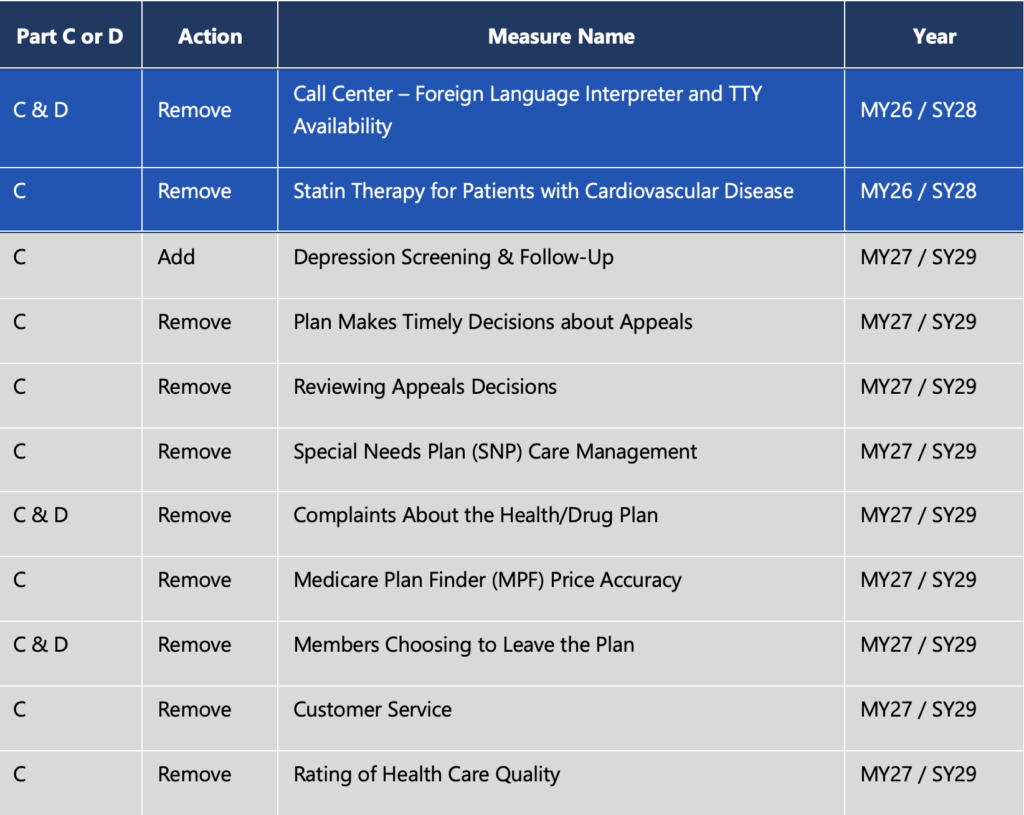
CMS is accelerating a shift away from administrative measures toward those that directly reflect member experience and clinical outcomes. As process-focused measures are phased out, performance will be driven by how members experience care and whether that care leads to meaningful health improvement, not how well processes are documented. While the Reward Factor remains in place and the Health Equity Index reward will not be implemented, the overall direction signals increased weighting on performance in areas that matter most to beneficiaries, including access, experience and outcomes. The table below outlines the 11 measure removals and additions that bring this shift to life across the Stars program.

11 measure removals and additions that bring shifts across the Stars program

The removal of these measures will shift domain weighting. Starting in SY2029, HEDIS will carry the greatest influence on overall Star ratings, reinforcing that clinical outcomes, not process, will drive performance.

Domain Weights

Quality Improvement (QI) not shown in domain weight total

The result is a more streamlined program with less margin for error. With fewer measures acting as buffers, performance will be driven by a concentrated set of core metrics with fewer opportunities to offset underperformance.

What This Means Now and What to Do About It

Success in this environment will require more than closing gaps at the measure level. As CMS continues to concentrate weight on outcomes, performance will be driven by a smaller, more sensitive set of metrics with far less room for error.

Plans need to quickly shift from managing measures to managing populations:

  • Which populations are actually driving performance?
  • Where are outcomes breaking down across the member journey?
  • Are interventions targeted or broadly deployed with limited impact?

At the same time, execution becomes more complex, not less.

Stars performance is no longer owned by a single team; itโ€™s produced across the organization. Performance depends on how well clinical operations, network strategy, pharmacy and member experience work together to drive outcomes. Gaps in alignment across these areas will show up quickly and financially.

CMS is also moving toward greater direct accountability. While certain measures (e.g., Appeals) are rolling out of Stars, they remain subject to audit and monitoring. The buffer that Stars once provided is shrinking. Performance, compliance and financial outcomes are becoming more tightly linked.

  • You still need to deliver on current-year performance
  • While simultaneously redesigning your strategy for whatโ€™s next
  • With limited resources, increasing financial pressure and no clear โ€œextra capacityโ€ to do both

Where ProspHire Can Help

Leading plans are already shifting their Stars strategy: moving from measure-level optimization to enterprise execution.

5 stars background

We partner with plans to move beyond strategy and into action:

  • Prioritizing what Matters Most – aligning investments and interventions to the populations and measures that drive performance
  • Turning Data into Action – understanding not just where gaps exist but why and what to do about them
  • Driving Cross-Functional Alignment โ€“ connecting clinical, pharmacy, experience and operations to deliver results
  • Integrating Stars Efforts End to End โ€“ bringing CAHPS, HEDIS and Part D into a cohesive, member-focused approach
  • Executing and Sustaining Change – supporting implementation and long-term adoption so strategies deliver lasting results

This is not a moment for theoretical strategies or incremental adjustments. It requires focused prioritization, strong partnership and disciplined execution. In a program with fewer measures and higher stakes, performance wonโ€™t be determined by strategy. It will be determined by execution.

Dentist and his assistant in dental office talking with young female patient and preparing for treatment.

Solving the Execution Gap in Dental Technology Implementation

As dental organizations modernize their technology environments, the conversation often focuses on selecting the right systems. But across the industry, leaders are discovering that technology alone does not drive transformation. Execution does.

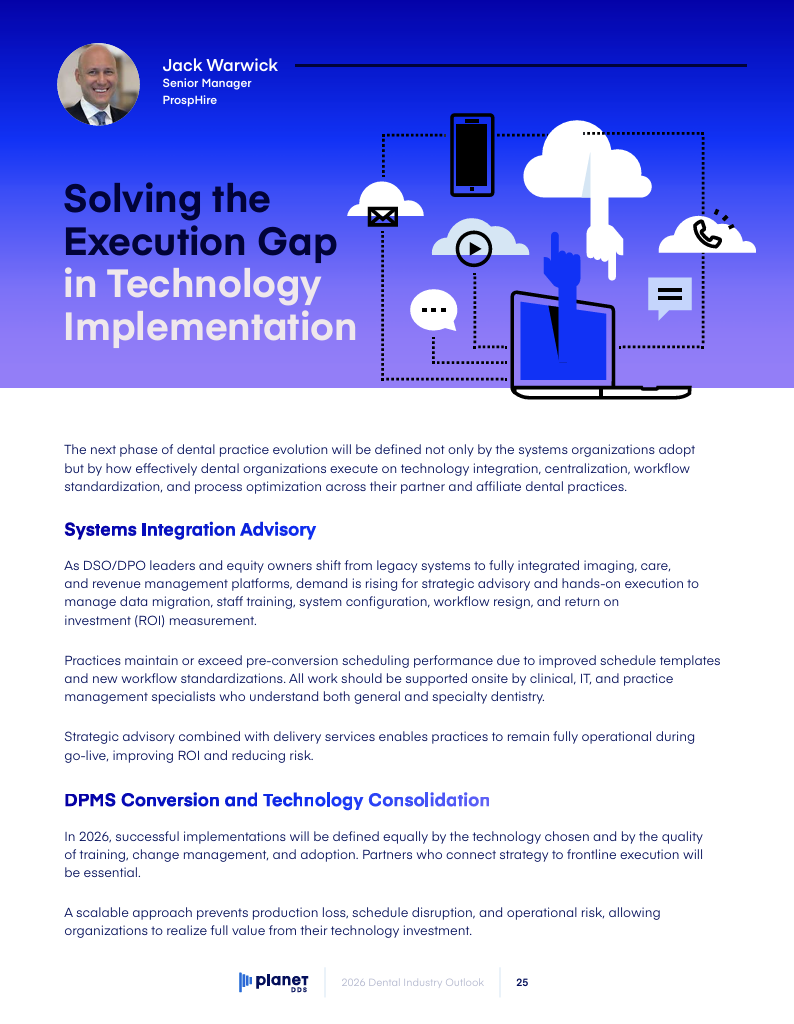
solving the execution gap in technology implementation

The report brings together perspectives from technology providers, advisors and industry leaders to examine the trends shaping dental organizations in the years ahead.

In the Planet DDS Dental Industry Outlook 2026, ProspHireโ€™s Jack Warwick explores the operational realities dental organizations face when implementing new platforms across multi-location practices. From data migration and system configuration to workflow redesign and staff training, successful implementations depend on disciplined execution and change management.

background image of gears

For dental support organizations and multi-location practices, the takeaway is clear: technology investments deliver value only when strategy, operations and frontline adoption move together.