
Let’s have a conversation
Medicare Advantage (MA), since its inception, has been on a meteoric rise. With more than half of all eligible seniors enrolled in the program, it remains a popular choice for consumers. However, the convergence of several factors over the past few years has marked a turning point for the program as we know it. Driven primarily by the COVID pandemic reset, rising utilization, increased regulatory scrutiny and an overinflated market, leading payors are rethinking previous models for success. What we’re seeing now are plans exiting key markets and launching resets of their own, including rethinking benefit designs, reducing administrative costs and considering the role of artificial intelligence in the context of managed cares, “new normal”. What worked yesterday, most certainly, will not work for tomorrow.
To be clear, this is not the end of Medicare Advantage; it is a paradigm shift. Those plans that seize this opportunity to take a hard look in the mirror and prepare themselves for the Medicare Advantage of tomorrow will most certainly be long term winners.
At ProspHire, we see four priorities that will define success for Medicare Advantage organizations in 2025 and beyond:
1. Define Your Goal, Then Recalibrate Portfolios, Products and Markets
The first step in navigating this reset is a strategic one, not an operational one. Too often, plans leap into tactical fixes without clarifying who they want to be. The fundamental question is: what is your goal?
- Do you want to be a growth leader, capturing market share and aggressively expanding into new geographies?
- Do you want to be a profitability leader, focusing on margin discipline and sustainable operations?
- Do you want to specialize in specific populations, such as dual eligibles or chronic condition cohorts?
Once that strategic identity is clear, portfolios and products must be recalibrated accordingly. The right benefits, the right markets and the right member segments should all ladder up to that core purpose. Without alignment, plans risk chasing growth in areas where the economics don’t work or overinvesting in products that don’t match their long-term strategy.
2. Revitalize Member Engagement

Action areas include:
- Proactive and personalized outreach, leveraging data to anticipate member needs.
- Intuitive tools and digital navigation that reduce confusion.
- A true focus on experience equity — meeting members where they are, across geography, culture and socioeconomic status.
Another important note looming in the MA space is that the first Gen X’er will be Medicare eligible in 2030, which is less than 5 years away. This represents an entirely new consumer segment with new expectations that plans will need to meet.
3. Invest in Technology and Infrastructure for Tomorrow
Success in MA is massively dependent on data: how it’s acquired, how it’s managed and how it’s used to make decisions. Many health plans today are still operating with fragmented systems, outdated analytics and cumbersome integrations. That is no longer sustainable.
The reset is the right moment to make serious infrastructure investments:
- Build robust IT and analytics capabilities that support real-time decision-making.
- Prepare for digital quality measurement and data submission in an ECDS/FHIR world.
- Reevaluate vendor relationships to ensure each partnership contributes to a smarter, more integrated tech stack.
The message is simple: technology is a competitive differentiator and plans that invest wisely now will be positioned to outpace competitors for the next decade.
4. Optimize Revenue Drivers: Stars, Quality and Risk
While the regulatory environment continues to shift, the core revenue levers of Medicare Advantage (Stars, quality and risk adjustment) remain central to financial sustainability. Yet these are often not given the investments required or siloed into business-as-usual functions rather than treated with the strategic importance they deserve.
Health plans must:
- Prioritize Stars improvement strategies that align with member experience, CAHPS and clinical outcomes.
- Consider new, innovative care delivery models, including PACE, neighborhood-driven clinical care delivery and other models to deliver care that members need.
- Tighten risk adjustment accuracy to avoid over- or under-coding exposures in a stricter audit environment.
- Treat quality not as an end but as a margin enabler, directly tied to reimbursement and member retention.
Even amid change, this truth remains: optimizing Stars, quality and risk is not optional. It is a foundational pillar of Medicare Advantage success.
What’s Next? Embrace the Reset and Seize the Opportunity
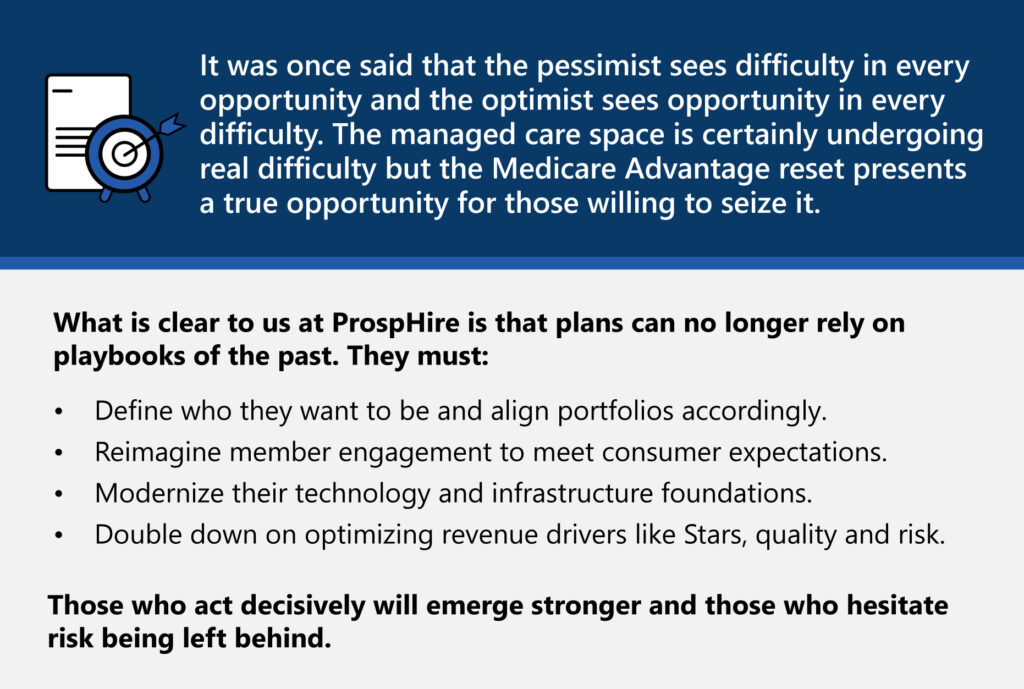
At ProspHire, we believe this is a moment for reinvention and a time for plans to confront hard questions, make bold choices and position themselves for long-term success. The Medicare Advantage of tomorrow will not look like yesterday’s version and that is precisely what makes this reset an opportunity worth seizing.