Author: LBodnarchuk

What Is Value-Based Healthcare? 

Jump to:

Traditional fee-for-service healthcare does not always provide a desirable system for all patients. It can result in inadequate or overpriced services, making it a less attractive option for many individuals.โ€ฏ 

Value-based care (VBC) is changing the landscape by lowering prices and boosting satisfaction for patients, payers and providers as well as aligning incentives and promoting quality care. 

We are exploring the different facets of VBC to help you better understand this care model. Learn what value-based healthcare really means, how it works, and its many benefits.โ€ฏย 

What Is Value-Based Care and How Does It Work? 

Value-based healthcare programs are designed to reward providers for delivering the highest quality of care. They involve incentive payments for the efficiency and ultimate effectiveness of the services delivered.โ€ฏThese systems work as a form of reimbursement and rival traditional healthcare programs that operate with retrospective payments based on bill charges.โ€ฏ 

The U.S. federal governmentโ€ฏfirst introduced VBC programs in 2008โ€ฏto improve healthcare services provided to people with Medicare as part of the Medicare Improvements for Patients and Providers Act (MIPPA). In 2010,โ€ฏthe Affordable Care Actโ€ฏ(ACA) also further advanced the development of value-based healthcare.โ€ฏ 

Today, both federal and commercial payers are leading the way in value-based care initiatives by focusing on common areas of duplication, supporting care pathways and evidence-based medicine goals. Removing unnecessary variation in care delivery means better outcomes and lower costs. 

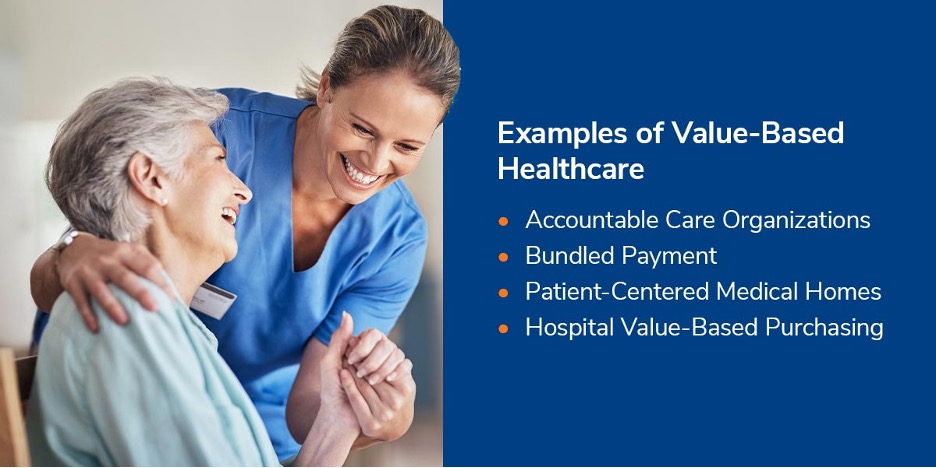
Examples of Value-Based Healthcare

Examples of Value-Based Healthcare 

Value-based healthcare is available in a variety of options. The following are some of the most popular programs you can choose from: 

Accountable Care Organizations 

Originally intended for Medicare patients, accountable care organizations (ACOs) coordinate various healthcare providers to offer coordinated care for a defined population of patients. Providers in the organization share not only the responsibility for improving care, but also the associated risks and incentives in quality performance metrics and lowering costs. While ACOs must invest in technology, people and processes to improve care, the risk arrangements often allow for returns on the investment. 

Bundled Payment 

A bundled payment, also called an episode-based payment, encompasses a program that allows patients to pay for an entire episode of treatment for medical and surgical care. The bundled payment methodology usually begins during hospitalization or surgical procedures and ends ninety days after the initiation of the bundle. This allows providers to emphasize not only the treatment provided within the hospital but the post-acute services, such as rehabilitation or nursing care afterward. It helps incentivize better care transitions and utilization of high-quality post-acute providers that keep the patient safe and avoid unnecessary readmissions. 

Patient-Centered Medical Homes 

A patient-centered medical home (PCMH) is another value-based healthcare model that is centered on a team-based approach to care, anchored in the primary care setting. Providers are typically reimbursed with additional payments to support a more patient-centric and care management delivery model often including services for physical health, mental health, wellness and around-the-clock availability to meet patient and caregiver needs.    

Hospital Value-Based Purchasing 

CMS has also established metrics for most US hospitals related to penalties and risks for quality and cost of care. The programs require hospitals to improve performance on hospital-acquired conditions, value-based purchasing and readmission reduction. These programs place a significant portion of Medicare revenue at risk for hospitals and allow hospitals to grow and support other providers in value-based arrangements. 

What Does Value-Based Care Mean for Payers and Providers?

Now is the time to consider examining or re-examining these programs and the impact on quality care and lowering costs. Are the current programs effective? Are patient outcomes improving and is the expense of operating in these models truly impacting cost? While research is mixed, there is no question that rethinking healthcare reimbursement is here to stay. The most successful organizations are finding the right combinations of care management, pathways, reimbursement and patient engagement that is pushing healthcare delivery in the right direction. 

There are several challenges to success in value-based care. One challenge is access and analysis of timely data that provides the necessary feedback on what is working and what may not be working in care delivery. Often data that providers see is outdated and not well presented to allow real-time interventions or change. 

Another challenge is the lack of coordination between payers and providers and coordinated use of resources for patient/member care management. Care management services may be offered by physician practices, hospitals and payers without a patient-centric approach which can be duplicative and sometimes conflicting. In an ideal system, these important care management and care transition services should be coordinated and focusing on ensuring patients are guided through chronic and acute illnesses and services without overlap or complications. 

Working together, payers, providers and patients can optimize value-based care models by learning from past experiences and continually finding new and innovative ways to align incentives, improve engagement and concentrate on quality outcomes and appropriate costs. 

ProspHire wants to help you provide the highest quality of care.

Turn to ProspHire to Learn More 

Value-based healthcare can assist in advancing the Quadruple Aim. From providing better care at lower costs to improving health management strategies, this type of care offers many benefits. 

At ProspHire, we want to help you provide the highest quality of care possible for your patients. With our team’s extensive healthcare industry knowledge and commitment to delivering valuable results, we are here to optimize your project resource management. 

Are you interested in learning more about how ProspHire can enhance your organization’s processes and improve your performance with integrated clinical care solutions?โ€ฏContact usโ€ฏbelow to get started today! 

Hannah Hess and pup

ProspHire Honors the Memory of Managing Director Hannah Hass

One year after ProspHire Managing Director Hannah Hass passed away, the Firm unveils โ€˜In Her Shoesโ€™, a Women in Leadership Training Program, in her honor. This program is focused on inspiring and empowering the women of the Firm through professional development.

โ€˜In Her Shoesโ€™ is a 6-week program that aims to develop future female leaders within ProspHire, focusing on driving innovation, creating high-performing teams, managing difficult situations and developing within your leadership style. โ€œIn memory of our colleague and dear friend, Hannah Hass, the โ€˜In Her Shoesโ€™ program is dedicated to making a positive impact on ProspHireโ€™s Women in Leadership by women empowering women,โ€ says Lauren Miladinovich, Co-founder, Managing Partner and CEO of ProspHire.

The oldest of three sisters, Hannah spent her early life exploring the hills and mountain rivers near Elkins, West Virginia. She loved being on the river and you could often find her sharing a kayak with her German Pinscher, Franz. She had a successful career as a consultant at Deloitte and moved on to build a loving work family at ProspHire, where she was admired by her colleagues for her independence, intelligence and humor. Hannah loved bringing people together.

Donations may be made in Hannahโ€™s name to Project HEAL.


Remembering ProspHire Senior Principal Advisor Rick Dorman

It is with great sadness that we inform of the passing of our friend and colleague Rick Dorman. After facing a battle with cancer, he died on November 12, 2022, with his family by his side. Our sincere condolences go out to Rick’s family during this difficult time.

โ€œRick represented the best qualities of an advisor, partner, mentor and teammate,โ€ said Lauren Miladinovich, Co-founder, Managing Principal and CEO of ProspHire. โ€œHe will be greatly missed by his colleagues across the Firm.โ€

Rick spent 27 years at Deloitte Consulting, becoming Principal in 1999. Upon retiring, he became an advisor at ProspHire. He was passionate about project management and business development. He was candid, but kind โ€“ he never held back. He was a man of sarcasm with much love behind it.

He was an active force on the ProspHire board of advisors and coached new and aspiring partners. Those who worked closely with Rick know how much pride he took in his profession and how he enjoyed life enthusiastically. His knowledge of wine often led to him being designated to select the wine for leadership team dinners.

โ€œMore than anyone I know, Rick loved life, he loved the profession and he loved ProspHire. He was the consummate teammate and friend and cared deeply for every staff member,โ€ shared Chris Miladinovich, Co-founder, Principal and Chief Operating Officer of ProspHire. โ€œTogether, we remember Rick and the indelible legacy he left at the Firm.โ€

Rick was a mentor to many, including ProspHireโ€™s Dan Crogan, Principal and SVP of Consulting, when he entered the Firmโ€™s partnership. โ€œRick brought a wealth of business knowledge to the executive leadership team, but more importantly he was a great man and dear friend,โ€ said Dan. โ€œHis patience and mentorship behind the scenes will be truly missed.โ€

Donations may be made in Rickโ€™s memory to the Target Cancer Foundation (www.targetcancerfoundation.org) or the Woodlands (www.mywoodlands.org).

ProspHire Makes Modern Healthcare’s Best Places to Work for a 3rd Year

PITTSBURGH, PA โ€“ ProspHire, a national management consulting firm focused on healthcare advisory, project delivery and strategic resourcing, announced today that for the 3rd year in a row, the Firm has ranked in the top ten on the Modern Healthcare Best Places to Work List under the category of healthcare supplier ranking 6th in 2022, 8th in 2021 and 5th in 2020.

Health, community, advancement and flexibility are the keys to attracting and engaging employees at the top organizations, according to the List. Each year this program singles out and recognizes outstanding employers in the healthcare industry on a national level.  

โ€œThe last few years have been incredibly challenging for the healthcare industry, so itโ€™s more important than ever to create an environment where our employees feel valued and fulfilled in their work,โ€ said Lauren Miladinovich, ProspHireโ€™s Co-Founder, Managing Principal and CEO. โ€œProspHire has such a strong and dedicated team and they are genuinely passionate about the Firm, our clients and our purpose to help people thrive every day.โ€

Christopher Miladinovich, ProspHireโ€™s Co-Founder, Principal and COO, said, โ€œThis award is an absolute honor and represents the strong culture that our entire team has built. We are very proud that our culture is committee led and championed by everyone at the Firm.โ€

ProspHire leaders believe you must start internally with employees who then lead you to great clients. โ€œItโ€™s exciting to be named to Modern Healthcareโ€™s List of Best Places to Work in Healthcare because this accolade is based on the views of our team members,โ€ said Dan Crogan, Principal and SVP of Consulting. โ€œPlacing in the top-10 three years in a row while going through such steep growth is a true testament to our incredible people.โ€

2022 has been another award-winning year for ProspHire. In addition to being named to Modern Healthcare Best Places to Work List three years in a row (2020-2022), ProspHire has been named to Inc. Magazineโ€™s annual list of Americaโ€™s Fastest Growing Private Companies for three years in a row โ€“ the Inc 5000 (2020-2022). The Firm also made the list for the Pittsburgh Business Times Fastest Growing Companies in the Pittsburgh region for four years in a row (2019 โ€“ 2022). That means we have built the trust of our clients through consistent and reliable results over time and have made significant investments in experienced resources to continue to provide high quality, healthcare specific professional services.

About ProspHire 

ProspHire is a national management consulting firm focused on healthcare advisory, project delivery and strategic sourcing. Founded on the core value of relationships, with the goal to โ€œprosper togetherโ€, ProspHire partners with clients to identify and solve their most significant people, process and technology challenges. The women-owned and rapidly growing Pittsburgh-based firm has nearly a 100 dedicated practitioners and consultants who deliver on projects and services across the U.S.  

Affordable Care Act Compliance Requirements

What Are the Affordable Care Act Compliance Requirements for Health Insurance Plans?

Jump to:

Healthcare and insurance are essential for Americans, allowing them to receive necessary treatments and prescriptions. The passage of the Affordable Care Act (ACA) transformed many healthcare requirements, from more accessibility to lower premium costs.

However, the ACA also brought in new compliance regulations. Understanding the new healthcare compliance standards and how they affect insurance plans is critical, but ACA compliance requirements can vary by insurance type, making it a challenge to keep up with every regulation.

Learn more about ACA compliance requirements and how you can stay compliant.

What Is ACA Compliance?

ACA compliance refers to healthcare plans that comply with the Affordable Care Act (ACA). Also known as Obamacare, the ACA was passed in 2010 to increase healthcare coverage. The law had these three goals:

  • Increase access to affordable health insurance.
  • Expand the Medicaid program.
  • Implement medical care delivery methods.

Overall, the ACA was a massive reform for health insurance plans in America. The act aimed to improve access, coverage and affordability of most health insurance types across the country. These are examples of some of its updates:

  • Health insurance exchanges: The ACA created health insurance exchanges. In these marketplaces, individuals and families can buy guaranteed issue qualified health insurance plans. A guaranteed issue plan means that issuers must offer products to all eligible individuals in the state. If an individual applies and meets all the eligibility requirements, the issuer must provide them with insurance.
  • Updated issue coverage: The law also updated guaranteed issue requirements. It prevents issuers from refusing coverage or charging higher premiums due to pre-existing conditions.
  • Premium subsidies: The ACA also offers subsidies for low- and middle-income purchasers. These subsidies can lower overall costs and make it easier for enrollees to afford coverage.
  • Coverage for essential health benefits: ACA-compliant plans must cover 10 essential health benefits. To comply with the ACA, health insurance plans must provide coverage for each element, from ambulance services to pregnancy care.

An ACA-compliant health insurance plan abides by all the new changes set in the ACA. All new insurance plans purchased after January 1, 2014, must be ACA-compliant. This law applies to both individual and group insurance plans. In other words, all plans after this date must reflect the changes passed by the Affordable Care Act.

All companies offernig insurance plans after January 1, 2014 must be ACA complaint.

What Companies Should Be ACA Compliant?

All companies offering insurance plans after January 1, 2014, must be ACA compliant. The coverage specifics depend on the type of insurance and health plan enrolleesโ€™ purchase. For instance, all companies with 50 or more employees must offer health insurance for their workers, but those with fewer than 50 aren’t required to.

Another differentiation with ACA compliance is with grandmothered or grandfathered plans. These healthcare plans took effect before 2014 and are subject to different compliance requirements.

Here is a closer look at these types of plans and their ACA requirements:

  • Grandmothered plans: These plans are also called transitional plans. They were created in the transitional period between 2010 and 2014, after the ACA had been signed into law but before it was in effect. Grandmothered plans must abide by some aspects of the ACA, such as the ban on lifetime maximums and coverage of essential health benefits. However, the rest of their coverage policies can stay the same as before 2014.
  • Grandfathered plans: Grandfathered plans were active before March 23, 2010. Similar to grandmothered plans, they can use their previous structures as long as they abide by some crucial ACA updates. They can remain in place indefinitely as long as providers don’t make significant changes.

What Are the Requirements for ACA Compliance?

While most health insurance plans must be ACA-compliant, the specifics of compliance vary. Here is an overview of the different types of health insurance types and ACA compliance requirements:

Individual and Family Coverage

Individual or family coverage plans are policies people purchase independently and not through their employer. For instance, an enrollee might buy a health insurance plan directly from a health insurance company rather than enroll through their worksite.

To comply with the ACA, individual plans must follow the outlined changes in the law. For example, all plans must feature:

  • Guaranteed issue to eligible applicants.
  • Coverage for pre-existing conditions.
  • Coverage for all essential health benefits.
  • No lifetime coverage maximum.

Small Group Coverage

The term “small group” refers to an employer or company that purchases health insurance for their employees. Businesses with 50 or fewer full-time employees are considered small groups. They are also required to comply with ACA requirements.

Small group requirements are very similar to the regulations for individual and family plans, including:

  • Guaranteed issue to eligible businesses.
  • Pre-existing conditions coverage.
  • No annual or lifetime limits.
  • All 10 essential health benefits covered.

Large Group Coverage

Employers with 51 or more full-time employees are considered large groups. The requirements for ACA compliance differ slightly for large group coverage. Many large group companies also choose self-insured plans, which can also follow large group rules.

ACA requirements for large groups include:

  • Mandated employee coverage: All employers with 50 or more full-time employees must offer health insurance to each employee. According to the Internal Revenue Service (IRS), a full-time employee is any worker who averages 30 hours or more of work each week.
  • Year-round guaranteed issue: Businesses can purchase plans year-round, allowing employees to enroll whenever necessary.
  • Coverage for minimum value: Large group insurance plans must cover a minimum value of at least 60% of average healthcare costs for each enrollee.
  • Coverage for preventative care costs: Unlike small group and individual plans, large group plans don’t need to cover all essential health benefits. However, large group plans must cover certain preventative care costs, such as cancer prevention or infectious disease prevention measures.
PropsHire works hard to ensure ACA government compliance.

Contact ProspHire Today to Stay ACA Compliant

Healthcare companies must stay compliant with ACA regulations.  If you have questions and concerns, use the form below to connect with one of our healthcare leaders today.

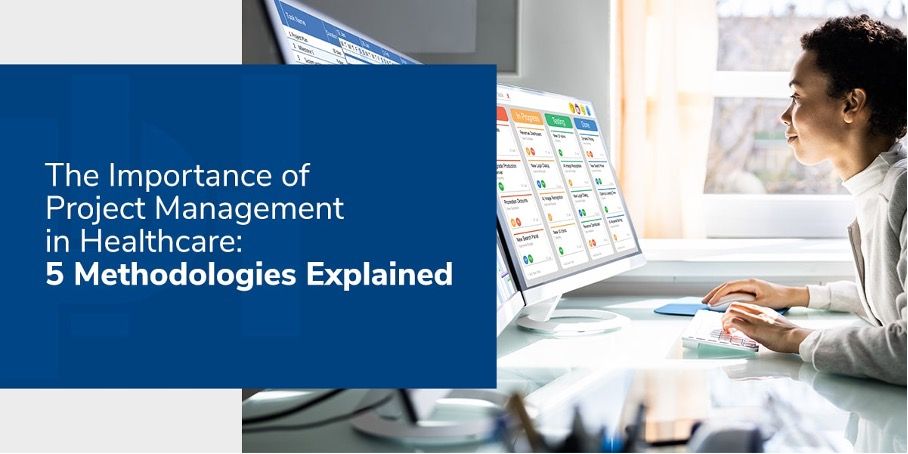
The importance of project management in healthcare: 5 methodologies explained

Why is Healthcare Project Management Important? 5 Methodologies Explained

Jump to:

Healthcare is one of the fastest-growing industries in the United States. Over the decade, the Bureau of Labor Statistics (BLS) projects healthcare occupations to grow 16%, adding over 2 million new jobs to the economy. Recent U.S. census data shows that 22 million workers are employed in the healthcare industry already.

Utilizing project management is essential in such a massive industry that continues to grow at an astounding pace. Continue reading to learn more about project management in healthcare.

Why Project Management in Healthcare Matters

Besides the scale of the healthcare industry, other factors contribute to project management’s importance in healthcare.

One prominent factor is the stakes involved with patient care. There’s no denying that healthcare is an essential part of any society, ensuring its members can prosper. Further, healthcare is necessary whenever tragedy strikes. For these reasons, people depend on well-organized, quality healthcare services.

As healthcare expands and technologies develop, project management only becomes more necessary. Things like electronic health records, regulatory limitations and diverse stakeholders add countless processes and regulations around patient safety, privacy and quality of care that healthcare project managers need to be mindful of. Also, the many parties involved in healthcare interactions further complicate matters.

In any given healthcare transaction, notable parties include:

  • Patients
  • Nurses
  • Physicians
  • Health insurance providers
  • Government agencies

Whereas many other industries have more simplistic buyer and seller relationships, healthcare has added complexities. Thus, project teams must be diverse and adaptable enough to consider all views, concerns and party interests.

To summarize, healthcare project management is essential because of:

  • Industry scale and accelerated growth rate
  • Stakes involved with patient care
  • Expanding technologies
  • Increased regulations
  • Diverse stakeholders
  • Complex relationships are involved with healthcare transactions

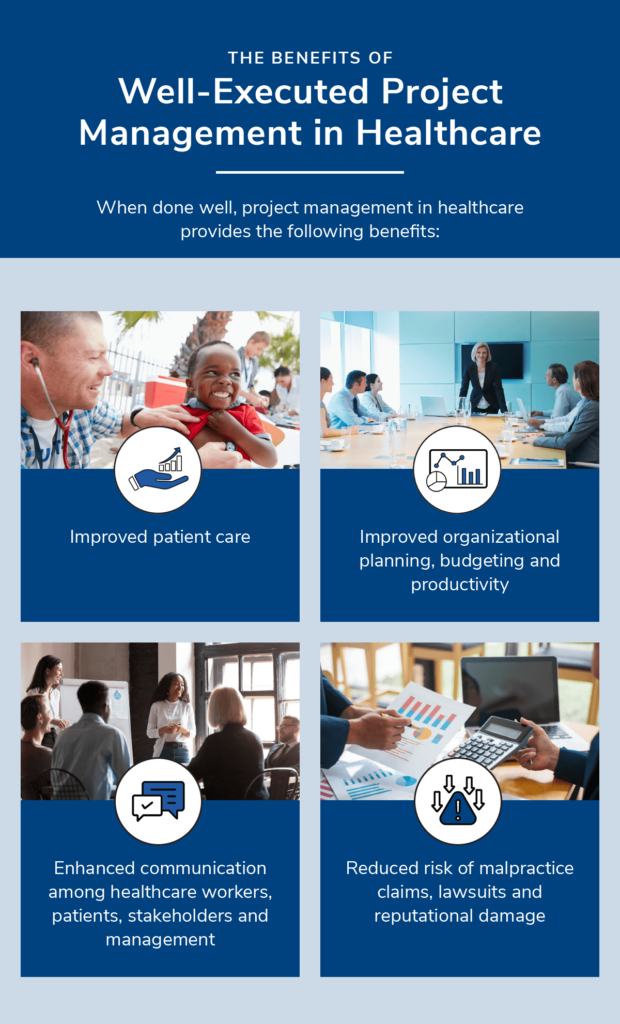
When done well, project management in healthcare can provide the following benefits:

  • Improved quality of care
  • Improved communication among healthcare workers, patients, management and shareholders
  • Improved organizational planning, budgeting and productivity
  • Decreased risk of lawsuits and malpractice claims
Micrographic depicting the benefits of well executed project management in healthcare

What Are the 5 Project Management Methodologies for Healthcare?

Project management methodologies are established principles and techniques that project developers and managers use to develop, carry out and manage projects. Here are brief explanations of five of the most popular project management methodologies:

 5 Project Management Methodologies Explained: Waterfall, Agile, Six Sigma, Scrum, Hybrid

1. Waterfall

The waterfall method is the most straightforward, linear and traditional approach to project management. It consists of several distinct phases that flow one after the other, just like a waterfall. Project managers using the waterfall method wait until each step is complete before moving on to the next one. Each phase is mapped out with clear expectations and desired outcomes and the project team regularly documents progress throughout each stage.

A key characteristic of waterfall projects is the use of Gantt charts. Such charts provide a visual overview of the project timeline with information on how long each phase will take. The waterfall approach is excellent for presenting a project to senior leadership and stakeholders.

The waterfall technique is also ideal for projects that require a rigid structure. Still, they can present difficulties for the project team to stick to the sequential, step-by-step process from beginning to end in process improvement projects when challenges inevitably arise.

2. Agile

Where the waterfall approach is slow and sequential, agile project management is fast and flexible. Agile methods follow an iterative approach of continual process refinement. The agile approach is much more open to change than waterfall project management, so long as it improves the process.

With project team structure, agile methods involve cross-functional team members who collaborate to drive the project forward. In this way, agile projects continually evolve as teams progress toward the end goal.

Still, a con of this approach is that it’s easy to get lost in minor details that provide minimal value to the project’s big picture. Agile projects especially run into this problem if the project’s big picture is vague to all team members. In the same way, they may seem less convincing to stakeholders and senior leadership when first pitched if the project’s big picture appears disorganized or lacks direction.

Agile projects involve stakeholders in project execution more than waterfall projects, which can prove beneficial if you can get past the first hurdle of getting approval. With that in mind, the agile method is great for industries with room for uncertainty and innovation.

3. Six Sigma

The Six Sigma process is all about continual process refinement. The main focus of the Six Sigma method is identifying and removing causes of defects and suboptimal efficiency in projects.

The results that the Six Sigma process aims to achieve are stable and expected. For this reason, Six Sigma project managers rely on quality management, empirical statistics and expert personnel in specific disciplines to bring the project to fruition.

Six Sigma projects require everyone from top to bottom to sustain project quality. This method works best in larger organizations.

4. Scrum

Scrum is a variation of agile project management involving project phases divided into short sprints. In contrast with the agile method, the scrum approach has smaller deliverables and more specific roles.

The lead role of a scrum project team is the scrum master, who forms and unites the group. Before each sprint, the scrum master assigns roles by asking each team member about their commitments and what they’ll accomplish concerning the project.

During each sprint, the scrum team holds daily scrum meetings to connect on progress, review commitments and address impediments. These meetings aim to sustain morale, ensure team members fulfill commitments and remove any obstacles to success. The scrum team also holds retrospective meetings at the end of each sprint to review accomplishments and what members can incorporate into the next sprint for continual process refinement.

The scrum method is great for projects that prioritize teamwork, quickness and efficiency.

5. Hybrid

The hybrid methodology merges the waterfall and agile methods, attempting to leverage the best of both. That said, the day-to-day operations of hybrid methods have a heavy focus on agile methods.

Hybrid methods use waterfall planning to present a clear roadmap to stakeholders and senior leadership for gaining approval. Having a clear roadmap also helps the execution team stay focused on the project’s big picture.

For example, a hybrid project may involve a structured rubric to present to stakeholders and senior leadership. That rubric is then broken down into detailed sets of tasks for the execution team. In this way, hybrid is a suitable method for projects that focus on improving outcomes.

Contact ProspHire to learn more about project management for healthcare.

Healthcare Project Management with ProspHire

ProspHire is a solutions-based healthcare consulting firm that will do everything in our power to help your organization thrive, expand and maximize ROI while remaining compliant with all regulations.

Contact ProspHire below to learn more about project management methods and start your project management strategy.